 Written by
 By: Dr. Stephanie Diana Eubank DBA
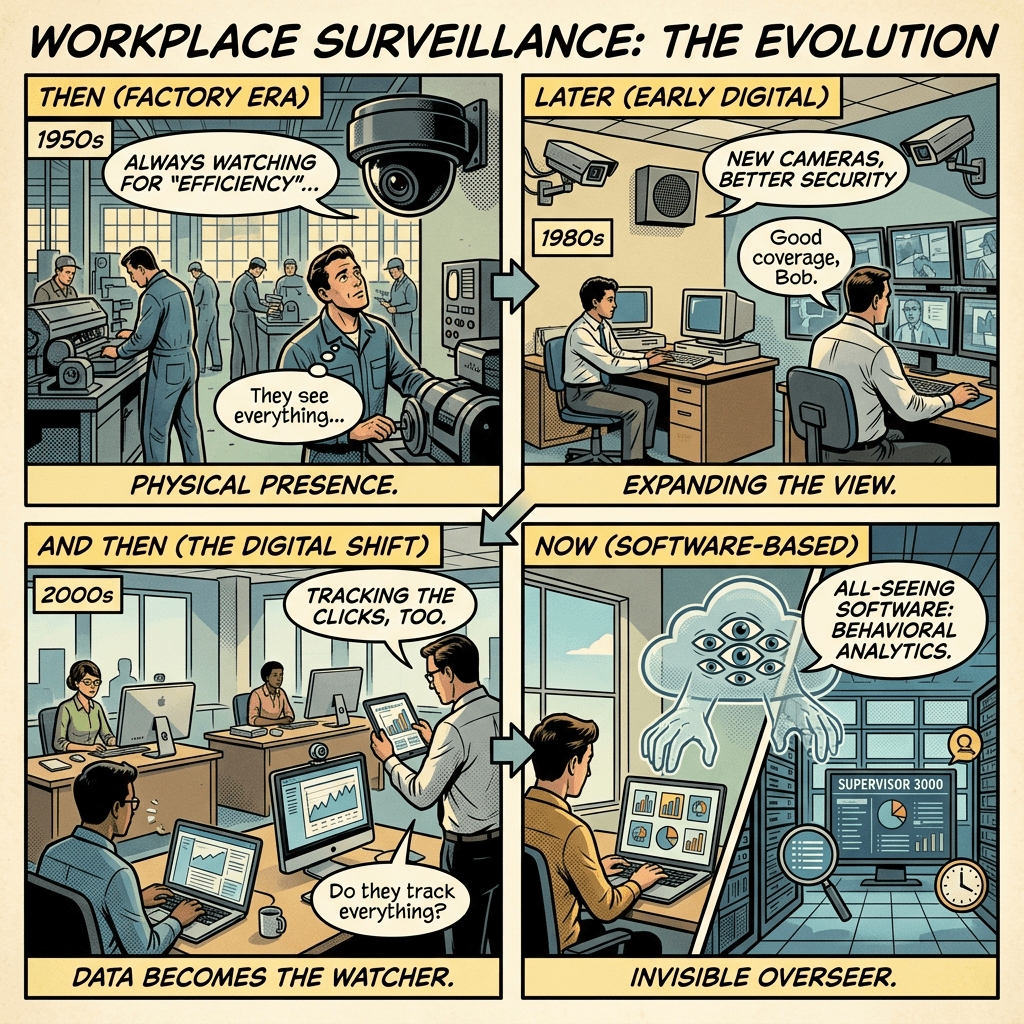
The current debate surrounding workplace surveillance often treats ‘bossware’ as a new phenomenon created by remote work. In reality, organizations have monitored employees for decades. Long before software tracked keystrokes, screenshots, mouse movements, and online activity, employers relied on physical observation systems such as cameras on manufacturing floors, warehouse monitoring systems, security checkpoints, and direct supervisory oversight. While the tools have evolved, the underlying goal remains largely unchanged: management seeks visibility into employee activity.
Today’s bossware has expanded beyond cameras and supervisors. Many organizations deploy activity-monitoring software that measures keyboard usage, application activity, idle time, login durations, and other quantitative metrics. These technologies are often marketed as productivity solutions. However, their primary focus is activity measurement rather than outcome measurement. The assumption that more visible activity automatically translates into better performance can create a false sense of control while overlooking the true drivers of organizational effectiveness.
Research from the U.S. Bureau of Labor Statistics (BLS) has identified positive relationships between remote work and productivity growth across multiple industries. The BLS found that industries experiencing greater increases in remote work also demonstrated positive associations with total factor productivity growth. These findings challenge the assumption that physical visibility is required for performance and suggest that well-designed remote work arrangements can contribute positively to productivity outcomes.
As discussed in Stephanie Eubank’s book, bosses often focus on management style while overlooking work modality. Micromanagers exist in both traditional offices and remote environments. Effective leadership can reduce turnover, increase engagement, and improve retention, but management style alone does not determine productivity. Organizations that concentrate exclusively on oversight mechanisms frequently miss opportunities to redesign work in ways that maximize employee effectiveness.
A practical distinction exists between retention and productivity. Management type can help stop the revolving door of constant hiring and replacement by creating stable, supportive workplaces. Work modality, however, can directly influence output by reducing interruptions, eliminating unnecessary commuting time, and allowing employees to structure work around periods of peak concentration. Whether a manager is highly involved or hands-off, employees still require conditions that support meaningful work.
Proponents of surveillance software often emphasize quantitative measurements such as keystrokes, active minutes, time online, or application usage. While these metrics may provide useful operational data, they do not capture qualitative productivity. An employee may spend fewer hours typing yet produce innovative solutions, improve customer relationships, streamline processes, or generate higher-quality deliverables. Likewise, an employee who appears constantly active on monitoring dashboards may not necessarily create meaningful value.
The future of performance management requires a more balanced framework. Organizations should evaluate both quantitative and qualitative indicators. Quantitative measures can assess volume, timeliness, and operational efficiency. Qualitative measures can evaluate innovation, problem-solving, collaboration, customer satisfaction, quality of work, and strategic impact. Together, these measures provide a more complete understanding of employee contributions.
Bossware is not a revolutionary management tool—it is simply the latest version of a decades-old surveillance tradition. From factory cameras to keyboard trackers, organizations have continually searched for ways to observe workers. Yet observation alone has never guaranteed productivity. The evidence increasingly suggests that organizations achieve better outcomes when they focus on trust, results, effective leadership, and work modalities that support sustained performance. Rather than asking how closely employees can be monitored, leaders should ask whether they are measuring the outcomes that actually matter.
References
Pabilonia, S. W., & Redmond, J. J. (2024). The rise in remote work since the pandemic and its impact on productivity. Beyond the Numbers, U.S. Bureau of Labor Statistics. https://www.bls.gov/opub/btn/volume-13/remote-work-productivity.htm
U.S. Bureau of Labor Statistics. (2025). Productivity and remote work. https://www.bls.gov/productivity/articles-and-research/remote-work/productivity-and-remote-work.htm
Eubank, S. (2025). [Referenced book by the author]. Amazon Kindle Direct Publishing. https://www.amazon.com/dp/B0H5BPJCHJ
If you enjoy this content like and subscribe. Additionally, if you are interested in consulting services, please feel free to reach out to me through my social media channels. Remember remote is here to stay.
YouTube: https://www.youtube.com/@Wickedbofthewest
Website: wickedbofthewestremoteconsulting.com
Facebook: https://www.facebook.com/WickedBoftheWestBusinessConsulting
Instagram: https://www.instagram.com/wickedbofthewestconsulting/
Blog: drstephaniebeardbaremoteresearch.org
LinkedIn: https://www.linkedin.com/in/stephanie-diana-eubank-dba/
TikTok: https://www.tiktok.com/@stephanie.eubank6
New Website: wickedbofthewestconsulting.com
Email: Drstephaniedeubank@wickedbofthewestconsulting.com or stephaniedeubank@gmail.com
TikTok: @stephaniedianaeubank
New Website: wickedbofthewestconsulting.com
Also, be sure to check out my first textbook on Operations Management. The book is titled “Remote Work Is Here to Stay: Rethinking Operations Management in the Modern Work Era.” You can purchase the textbook on Amazon at the link below.

