 Written by
 By: Dr. Stephanie Diana Eubank DBA
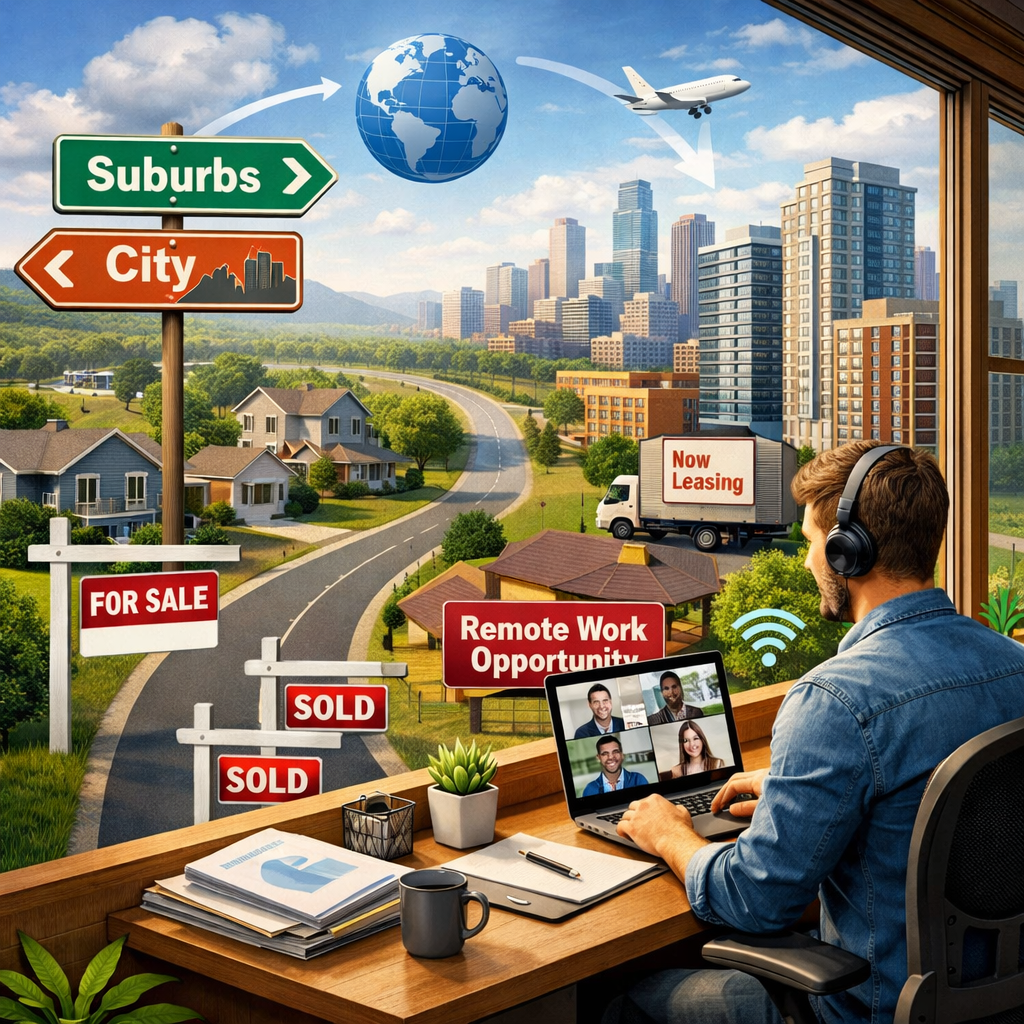
Remote work is no longer simply a workforce accommodation—it has become a powerful economic force reshaping housing markets, regional development, and long-term economic stability. One of the sectors most visibly transformed by the rise of remote work is real estate. Evidence from the COVID‑19 era shows that remote work redistributed housing demand, revitalized historically stagnant real estate markets, and generated downstream investment in infrastructure and local economies.
During the COVID‑19 pandemic, widespread adoption of remote work fundamentally altered residential mobility patterns. Economists using U.S. Postal Service change‑of‑address data and Zillow housing transactions documented significant out‑migration from high‑cost urban cores toward suburbs, small cities, and rural regions. Ramani and Bloom (2021, 2024) describe this phenomenon as the “Donut Effect,” in which demand hollowed out from city centers while growing in surrounding and smaller communities. These movements were driven by the reduced need for daily commuting made possible by remote and hybrid work.
Importantly, this migration was not limited to suburban growth. Research shows that regions experiencing long‑term population decline or stagnant housing demand saw net in‑migration for the first time in decades. Studies using national and international datasets found that rural and lower‑density regions benefited disproportionately from remote‑enabled migration, especially among younger and higher‑skilled workers (Knüpling et al., 2025; Petersen et al., 2024). As demand increased in these areas, real estate transactions accelerated, stabilizing or reversing previously sluggish housing markets.
Increased housing demand outside traditional metro hubs has driven local governments and private developers to invest in infrastructure. Broadband expansion, road upgrades, utilities, and mixed‑use development have followed population inflows into small cities and rural counties. Empirical research demonstrates that remote work not only raises local housing prices but also supports broader economic activity by increasing consumer spending and encouraging long‑term residence rather than short‑term commuting patterns (Mikawa et al., 2026; Monte et al., 2025).
These investments create a reinforcing cycle: improved infrastructure attracts additional residents and businesses, further strengthening regional economies. Rather than draining urban economies, remote work has redistributed growth more evenly across geographic regions, reducing pressure on overcrowded cities while revitalizing underutilized communities.
Remote work has also altered the type of housing workers can afford. Prior to the pandemic, many workers were constrained to expensive metropolitan areas where homeownership was often out of reach, leading individuals to invest in small condominiums or remain perpetual renters. Remote work has expanded geographic choice, allowing workers to purchase single‑family homes in more affordable regions.
Economic analysis from the National Bureau of Economic Research estimates that remote work explains more than half of the increase in U.S. housing demand between 2019 and 2023, driven primarily by increased demand for larger homes suitable for work‑from‑home arrangements (Mondragon & Wieland, 2025). This shift has enabled households to build equity through homeownership instead of concentrating wealth accumulation in a limited number of high‑density urban markets.
The ability to relocate without sacrificing employment has meaningful social and economic implications. Remote work allows workers to move closer to extended family, reduce childcare costs, and minimize commuting expenses. Lower housing costs in non‑metro regions free household income for savings, local consumption, and education investment. Research shows that employees value this geographic flexibility and are more likely to remain with employers offering remote options, contributing to workforce stability and sustained economic participation (Bloom et al., 2024; Aksoy et al., 2025).
At the macroeconomic level, these cost savings increase labor force participation by making employment viable for caregivers and geographically constrained workers, strengthening the overall economy.
Remote work should be understood as a structural reconfiguration of labor and housing markets rather than a temporary pandemic anomaly. Evidence indicates that remote and hybrid work levels have stabilized at rates far above pre‑pandemic norms, suggesting durable impacts on real estate and regional growth (Barrero et al., 2025). This persistence allows communities to plan long‑term development strategies with confidence.
By enabling workers to live where housing is affordable, families are supported, and quality of life is higher, remote work promotes more balanced economic development. For the real estate sector, this means broader market participation, reduced volatility concentrated in a handful of cities, and sustained demand across a wider geographic footprint.
Ultimately, remote work strengthens the economy by aligning housing markets with modern labor realities. When workers are free to choose locations that fit their financial and familial needs, real estate markets diversify, infrastructure investment follows, and economic growth becomes more resilient and inclusive.
References
Aksoy, C. G., Barrero, J. M., Bloom, N., Davis, S. J., Dolls, M., & Zarate, P. (2025). *The global persistence of work from home*. Hoover Institution.
Barrero, J. M., Bloom, N., & Davis, S. J. (2025). *Why working from home will stick*. National Bureau of Economic Research.
Knüpling, L., Sternberg, R., & Otto, A. (2025). Rural areas as winners of COVID‑19, digitalization and remote working? *Cambridge Journal of Regions, Economy and Society, 18*(1), 227–248. https://doi.org/10.1093/cjres/rsae033
Mikawa, N., Naoi, M., & Yasuda, S. (2026). COVID‑19, teleworking, and the real estate market. *Journal of Real Estate Finance and Economics*. https://doi.org/10.1007/s11146-026-10052-z
Mondragon, J. A., & Wieland, J. (2025). *Housing demand and remote work* (NBER Working Paper No. 30041). National Bureau of Economic Research. https://doi.org/10.3386/w30041
Monte, F., Porcher, C., & Rossi‑Hansberg, E. (2025). *Remote work and city structure* (NBER Working Paper No. 31494). National Bureau of Economic Research.
Ramani, A., & Bloom, N. (2021). *The donut effect of COVID‑19 on cities* (NBER Working Paper No. 28876). National Bureau of Economic Research.
Ramani, A., Alcedo, J., & Bloom, N. (2024). How working from home reshapes cities. *Proceedings of the National Academy of Sciences, 121*(44).
Petersen, J. K., Winkler, R. L., & Mockrin, M. H. (2024). Changes to rural migration in the COVID‑19 pandemic. *Rural Sociology*.
If you enjoy this content like and subscribe. Additionally, if you are interested in consulting services, please feel free to reach out to me through my social media channels. Remember remote is here to stay.
YouTube: https://www.youtube.com/@Wickedbofthewest
Website: wickedbofthewestremoteconsulting.com
Facebook: https://www.facebook.com/WickedBoftheWestBusinessConsulting
Instagram: https://www.instagram.com/wickedbofthewestconsulting/
Blog: drstephaniebeardbaremoteresearch.org
LinkedIn: https://www.linkedin.com/in/stephanie-diana-eubank-dba/
TikTok: https://www.tiktok.com/@stephanie.eubank6
New Website: wickedbofthewestconsulting.com
Email: Drstephaniedeubank@wickedbofthewestconsulting.com or stephaniedeubank@gmail.com
TikTok: @stephaniedianaeubank
New Website: wickedbofthewestconsulting.comtconsulting.com
 Dr. Stephanie Diana Eubank DBA Remote Team Research (AKA Dr. Bear)