 Written by
 By: Dr. Stephanie Diana Eubank DBA
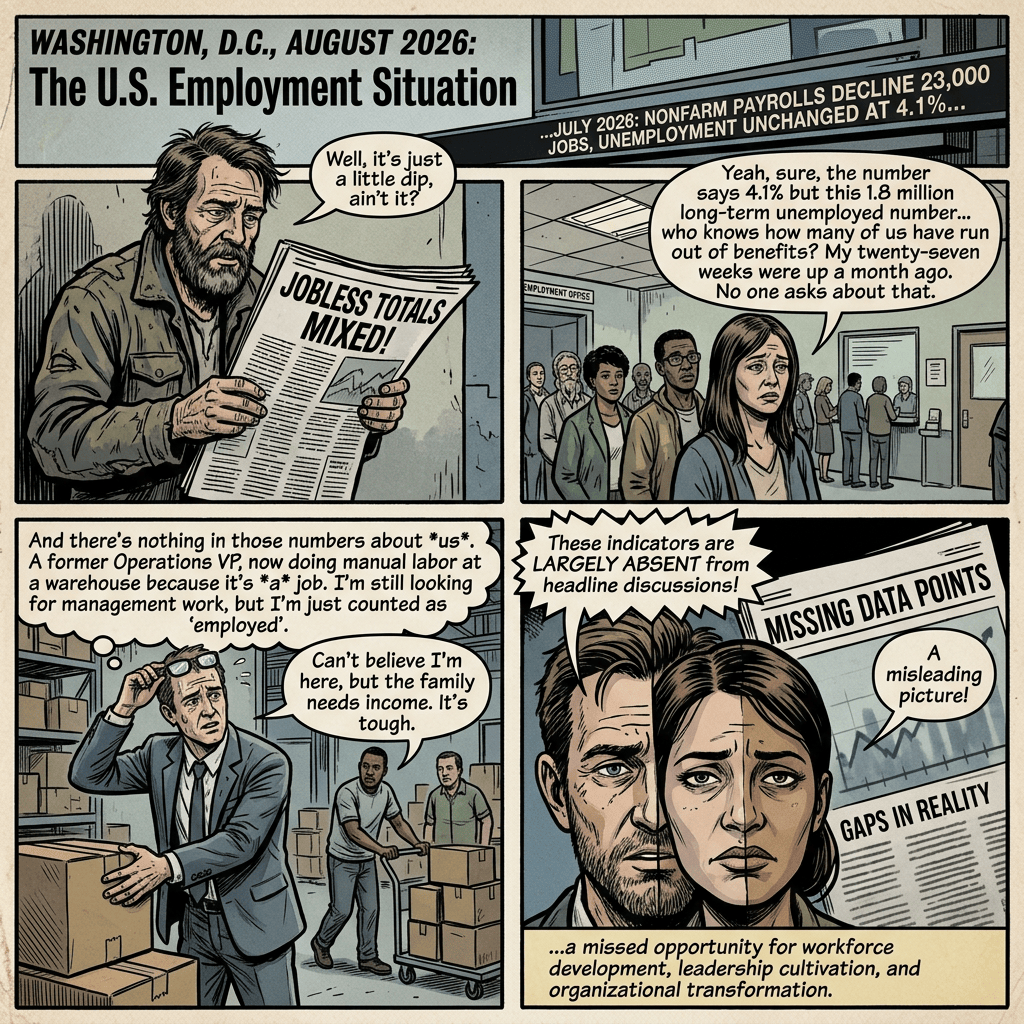
The July 2026 U.S. Employment Situation report showed nonfarm payroll employment declining by 23,000 jobs while unemployment remained at 4.1%. However, two critically important workforce indicators remain largely absent from headline discussions. First, the report identifies 1.8 million long-term unemployed individuals who have been jobless for 27 weeks or longer, but it does not quantify how many have exhausted unemployment benefits or stopped receiving support but are still looking for employment. Second, national reporting does not adequately capture the growing number of highly skilled professionals, managers, executives, and specialists who are accepting lower-level positions simply to maintain income while continuing their search for roles aligned with their qualifications. These gaps create a misleading picture of labor market health and represent a missed opportunity for workforce development, leadership cultivation, and organizational transformation.
According to the Bureau of Labor Statistics (2026), approximately 1.8 million Americans were unemployed for 27 weeks or longer in July 2026, representing 25.5% of all unemployed workers. While the report tracks long-term unemployment, it does not report how many individuals have exhausted unemployment insurance eligibility. As a result, policymakers and employers may underestimate the financial and professional hardships facing experienced workers who have remained disconnected from meaningful employment.
Similarly, the official report does not measure the number of executives, project managers, engineers, analysts, educators, technology professionals, and other specialists who have accepted entry-level or lower-paying positions. This phenomenon, often referred to as underemployment, can conceal significant labor market stress. Workers may disappear from unemployment statistics while still being substantially underutilized.
Organizations frequently report talent shortages while simultaneously overlooking experienced professionals already present in the labor market. The decline in labor force participation to 61.4% suggests that many workers may be disengaging from the job market entirely. Economists have noted that declining long-term unemployment figures may actually reflect discouraged workers leaving the labor force rather than successfully obtaining suitable employment.
Rather than focusing exclusively on external recruitment, organizations have an opportunity to leverage workforce development strategies that maximize existing talent. Companies can expand internal mobility programs, create structured leadership pipelines, and redesign roles to better align employee capabilities with business needs.
One of the most overlooked solutions is the application of Six Sigma principles, process improvement initiatives, and cross-functional training programs. Many organizations maintain workforce silos that limit employee growth and organizational flexibility.
Through strategic cross-training, employees can develop competencies across departments while organizations build resilience against staffing shortages and economic uncertainty. Existing employees can be reshuffled into roles that better utilize their strengths while simultaneously creating advancement pathways for emerging leaders.
Organizations that invest in leadership development, Lean methodologies, process design, and workforce analytics gain a significant competitive advantage. Rather than viewing workforce challenges as a hiring problem alone, they can leverage existing talent, improve retention, and reduce the costs associated with external recruitment.
The July 2026 jobs report should be viewed as a call to action. Beneath the headline numbers is a substantial pool of experienced workers with leadership potential, specialized expertise, and operational knowledge. Many are seeking opportunities to contribute at higher levels than the positions they currently occupy.
Forward-thinking organizations can capitalize on this environment by implementing intentional workforce development programs. Developing leadership capabilities, succession planning initiatives, and career progression frameworks can transform underutilized talent into future organizational leaders.
As the founder of Wicked B of the West Business Consulting, I offer professional development courses designed to help organizations understand workforce trends, identify hidden talent, implement cross-training frameworks, develop remote leadership capabilities, and build scalable workforce development strategies. These programs help companies leverage labor market realities to attract, retain, and cultivate top talent.
Organizations interested in strengthening leadership pipelines, implementing Six Sigma-informed workforce development strategies, and improving organizational effectiveness can learn practical approaches through these courses and consulting programs.
For readers interested in workforce development, leadership, neurodiversity, remote work, and organizational design, my latest book is now available on Amazon. The book explores practical strategies for creating inclusive, adaptive workplaces capable of thriving in rapidly changing economic environments.
The July 2026 jobs report presents important labor market data, but it leaves crucial questions unanswered. How many long-term unemployed workers have exhausted benefits? How many highly qualified professionals are working below their skill level? Until these measures are tracked more effectively, employers risk overlooking a tremendous opportunity to cultivate leadership, strengthen workforce capability, and unlock hidden talent already available in the labor market.
References
Bureau of Labor Statistics. (2026, August 7). The Employment Situation – July 2026. U.S. Department of Labor. https://www.bls.gov/news.release/empsit.htm
Bureau of Labor Statistics. (2026, August 13). 1.8 million people had been unemployed 27 weeks or longer in July 2026. The Economics Daily. https://www.bls.gov/opub/ted/2026/1-8-million-people-had-been-unemployed-27-weeks-or-longer-in-july-2026.htm
Iacurci, G. (2026, August 7). Falling long-term unemployment isn’t good news, economists say. CNBC. https://www.cnbc.com/2026/08/07/long-term-unemployment-job-market-workers-labor-force.html
Book Information
Remote Work Is Here to Stay: Rethinking Operations Management in the Modern Work Era
Available on Amazon: https://www.amazon.com/dp/B0H5BPJCHJ
If you enjoy this content like and subscribe. Additionally, if you are interested in consulting services, please feel free to reach out to me through my social media channels. Remember remote is here to stay.
YouTube: https://www.youtube.com/@Wickedbofthewest
Website: wickedbofthewestremoteconsulting.com
Facebook: https://www.facebook.com/WickedBoftheWestBusinessConsulting
Instagram: https://www.instagram.com/wickedbofthewestconsulting/
Blog: drstephaniebeardbaremoteresearch.org
LinkedIn: https://www.linkedin.com/in/stephanie-diana-eubank-dba/
TikTok: https://www.tiktok.com/@DrStephanieDEubank
New Website: wickedbofthewestconsulting.com
Email: stephaniedeubank@gmail.com
TikTok: @DrStephanieDEubank
New Website: wickedbofthewestconsulting.com
Also, be sure to check out my first textbook on Operations Management. The book is titled “Remote Work Is Here to Stay: Rethinking Operations Management in the Modern Work Era.” You can purchase the textbook on Amazon at the link below.

