 Written by
 By Dr. Stephanie Diana Eubank, DBA
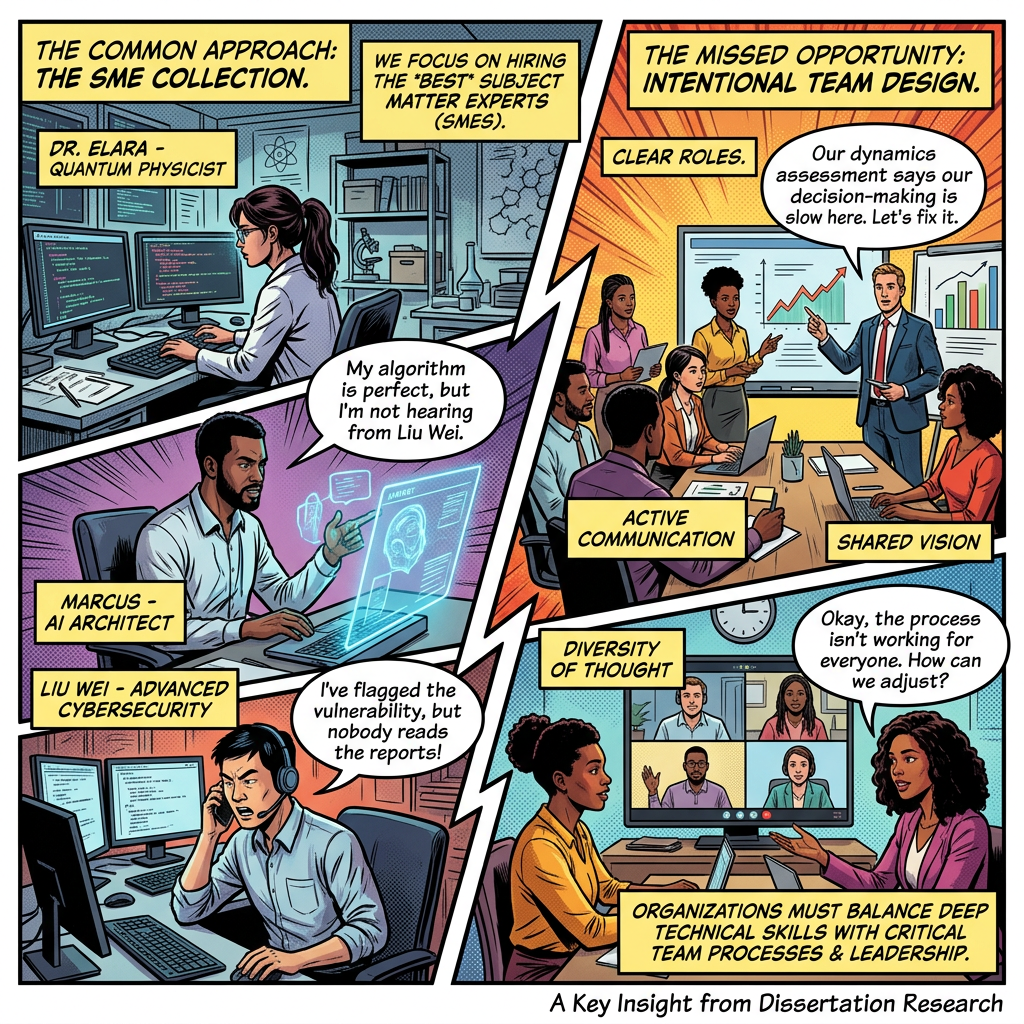
One of the most significant findings from my dissertation research was that leaders in both traditional in-person environments and remote work environments frequently fail to utilize intentional team design strategies. Instead, organizations often focus heavily on hiring subject matter experts (SMEs) with deep technical expertise while paying far less attention to team dynamics, communication styles, collaboration capabilities, and leadership structures.
While technical expertise is important, my research aligned with a growing body of literature suggesting that expertise alone does not create high-performing teams. In many cases, organizations unintentionally create conditions that mirror what Meredith Belbin described as the Apollo Effect, sometimes called Apollo Syndrome. Researchers have found that teams composed primarily of highly capable experts can underperform because individuals become overly focused on their own areas of expertise, priorities, or perspectives rather than collective team objectives.
The Apollo Effect in Modern Organizations
Belbin’s research demonstrated that teams filled with highly intelligent and accomplished individuals often struggled with collaboration, shared decision-making, and consensus-building. These teams frequently experienced excessive debate, siloed thinking, competing priorities, and reduced team cohesion. Rather than leveraging the collective strength of the group, members operated independently and unintentionally undermined overall team effectiveness. In some cases, so-called ‘dream teams’ performed worse than teams with fewer technical superstars but stronger collaboration and leadership structures.
What makes this particularly important today is that the Apollo Effect is not limited to in-person teams. Similar challenges can emerge in remote and hybrid work environments when leaders fail to establish communication systems, accountability structures, knowledge-sharing practices, and role clarity.
Remote and In-Person Teams Share the Same Design Problem
One misconception is that remote work creates team dysfunction. My research suggests a different conclusion. The problem is often not the work location itself. The problem is poor team design.
Organizations frequently invest substantial resources identifying technical experts while neglecting the human systems required for collaboration. When selection decisions prioritize expertise above communication, documentation, adaptability, and teamwork, organizations create conditions where the Apollo Effect can thrive regardless of whether employees work in an office, remotely, or through a hybrid arrangement.
The Entry-Level Experience Paradox
Another concerning trend is the growing expectation that applicants possess extensive experience for positions traditionally considered entry level. Organizations increasingly seek candidates with years of experience, advanced credentials, and extensive technical knowledge while offering compensation and advancement opportunities associated with early-career positions.
The result is an organizational imbalance. Teams become overpopulated with specialists competing for limited advancement opportunities. Highly qualified employees enter roles beneath their experience levels, while organizations simultaneously struggle with retention, engagement, and leadership development. This practice can contribute to weakened organizational culture and reduced team sustainability because employees often feel underutilized, disconnected, or uncertain about long-term growth opportunities.
Building Sustainable Teams
Organizations seeking long-term success should expand their hiring and workforce development strategies beyond technical expertise. Effective team design includes role diversity, communication competencies, collaborative problem-solving, psychological safety, documentation practices, accountability systems, and leadership development.
The most successful teams combine subject matter expertise with relationship-building capabilities. They balance technical knowledge with coordination, knowledge sharing, and a commitment to collective outcomes.
A Chapter Dedicated to the Apollo Effect
These themes are explored in greater detail in my book, Remote Work Is Here to Stay: Rethinking Operations Management in the Modern Work Era, now available on Amazon. One chapter specifically examines the Apollo Effect, discusses how it impacts both remote and traditional workplaces, and provides practical leadership strategies for designing resilient, sustainable, and high-performing teams.
As organizations continue adapting to the future of work, leaders must move beyond the assumption that a collection of experts automatically becomes a high-performing team. Sustainable success requires intentional team design, leadership development, and organizational systems that encourage collaboration rather than competition.
References (APA 7th ed.)
Belbin. (n.d.). Belbin Apollo teams. https://www.belbin.com/resources/articles-directory/belbin-apollo-teams
Gershkov, A., & Schweinzer, P. (2021). Dream teams and the Apollo effect. Journal of Mechanism and Institution Design, 6(1), 113-148.
Gallup. (2025). A strategic guide for managing hybrid and remote teams. https://www.gallup.com/workplace/316313/understanding-and-managing-remote-workers.aspx
Book Information
Remote Work Is Here to Stay: Rethinking Operations Management in the Modern Work Era
Available on Amazon: https://www.amazon.com/dp/B0H5BPJCHJ
If you enjoy this content like and subscribe. Additionally, if you are interested in consulting services, please feel free to reach out to me through my social media channels. Remember remote is here to stay.
YouTube: https://www.youtube.com/@Wickedbofthewest
Website: wickedbofthewestremoteconsulting.com
Facebook: https://www.facebook.com/WickedBoftheWestBusinessConsulting
Instagram: https://www.instagram.com/wickedbofthewestconsulting/
Blog: drstephaniebeardbaremoteresearch.org
LinkedIn: https://www.linkedin.com/in/stephanie-diana-eubank-dba/
TikTok: https://www.tiktok.com/@ DrStephanieDEubank
New Website: wickedbofthewestconsulting.com
Email: stephaniedeubank@gmail.com
TikTok: @ DrStephanieDEubank
New Website: wickedbofthewestconsulting.com
Also, be sure to check out my first textbook on Operations Management. The book is titled “Remote Work Is Here to Stay: Rethinking Operations Management in the Modern Work Era.” You can purchase the textbook on Amazon at the link below.
 Dr. Stephanie Diana Eubank DBA Remote Team Research (AKA Dr. Bear)