 Written by
By: Dr. Stephanie Diana Eubank DBA
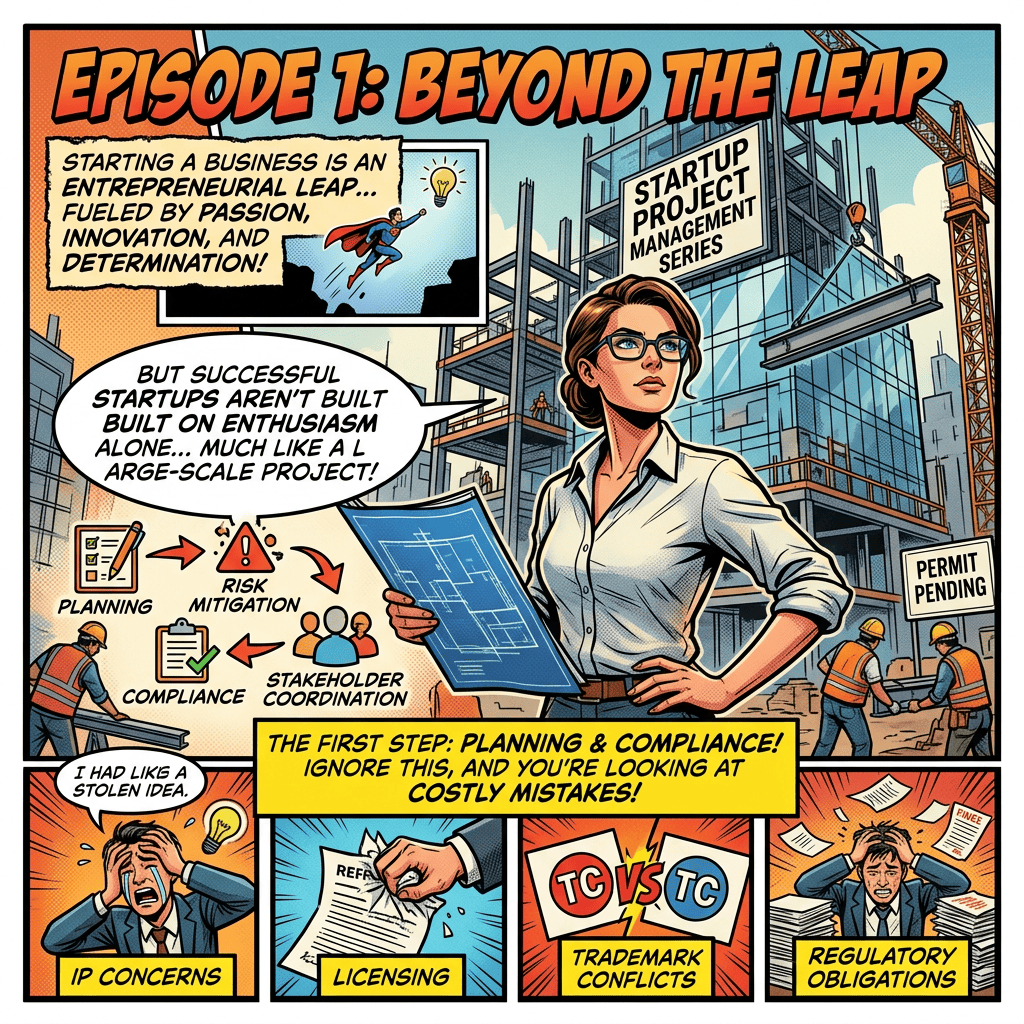
Starting a business is often viewed as an entrepreneurial leap fueled by passion, innovation, and determination. However, successful startups are not built on enthusiasm alone. Much like a large-scale project management initiative, launching a business requires careful planning, risk mitigation, compliance management, and stakeholder coordination. This first article in the Startup Project Management Series focuses on the planning and compliance phase of business development. Failure to address intellectual property concerns, licensing requirements, trademark conflicts, contractual disclosures, and regulatory obligations can create significant legal and financial challenges for new business owners. This article explores the importance of compliance planning and identifies practical resources entrepreneurs can use to protect their businesses and avoid costly mistakes.
Starting a Business Is a Project Management Exercise
Many entrepreneurs focus heavily on product development, branding, marketing, and sales. While these activities are important, they represent only a portion of what is required for a successful startup launch.
Project management professionals understand that every major initiative begins with a planning phase. According to project management principles, organizations that invest significant effort in planning are often better equipped to manage risk, allocate resources effectively, and achieve desired outcomes. A startup functions much like a complex project with multiple workstreams, stakeholders, deadlines, deliverables, and compliance requirements.
Business owners must simultaneously manage:
- Market research
- Product or service development
- Legal compliance
- Intellectual property protection
- Financial planning
- Vendor management
- Contract development
- Licensing and permits
- Marketing strategy
- Risk management
The reality is that the devil is often in the details.
The Compliance Trap
One of the most common mistakes made by startups is treating compliance as an afterthought. Entrepreneurs frequently assume that if they have a great idea and a strong customer base, legal and regulatory details can be addressed later.
Unfortunately, later can be expensive.
Failure to complete compliance planning can result in:
- Trademark infringement claims
- Copyright violations
- Cease-and-desist orders
- Business license penalties
- Contract disputes
- Consumer disclosure violations
- Rebranding expenses
- Litigation costs
Just as project managers build risk management plans, startup founders should create a compliance management plan before opening their doors.
Step One: Research Existing Businesses
Before investing significant money into branding and marketing, entrepreneurs should carefully review businesses that provide similar goods or services within their geographic market.
Questions to ask include:
- Does another local business already use a similar name?
- Is another company providing substantially similar services?
- Are there potential trademark conflicts?
- Does your branding closely resemble a competitor’s?
Competitive analysis should extend beyond local competitors and include state and national searches.
Step Two: Search Existing Trademarks
Business owners should conduct trademark clearance searches before selecting a company name, product name, slogan, or logo. The United States Patent and Trademark Office (USPTO) recommend searching for similar marks before filing an application because conflicts can result in a likelihood-of-confusion refusal. The USPTO provides free trademark search tools for public use (United States Patent and Trademark Office [USPTO], n.d.).
Helpful Resources:
- USPTO Trademark Search System
- USPTO Trademark Center
- Trademark Electronic Search Resources
- State trademark databases
Website: https://www.uspto.gov/trademarks
Step Three: Conduct Intellectual Property Reviews
Many startups unknowingly infringe upon copyrights, trademarks, or patents when developing websites, marketing materials, logos, photographs, product designs, or educational content.
The U.S. Copyright Office explains that copyright protection exists automatically when an original work is fixed in a tangible medium of expression. Copyright protects original works such as website content, advertisements, manuals, videos, graphics, and promotional materials. Businesses using copyrighted content without permission may face infringement claims (U.S. Copyright Office, n.d.).
Areas commonly overlooked include:
- Website images
- Social media graphics
- Online articles
- Training materials
- Marketing videos
- AI-generated content
- Product manuals
- Music used in promotional videos
Helpful Resources:
- U.S. Copyright Office: https://www.copyright.gov
- Copyright Basics Guide
- Copyright Registration Portal
Step Four: Verify Licensing and Permit Requirements
Many entrepreneurs do not realize that licensing requirements vary by federal, state, county, and city jurisdictions.
The U.S. Small Business Administration advises business owners to research applicable licenses and permits before beginning operations because regulations vary according to location and business activity.
Common examples include:
- Business licenses
- Seller permits
- Professional certifications
- Health permits
- Food handling permits
- Home occupation permits
- Sign permits
- Employer registrations
California entrepreneurs can also review startup requirements through the California Secretary of State and CalGOLD permitting resources.
Step Five: Review Contracts and Required Disclosures
Entrepreneurs should ensure that contracts contain appropriate disclosures and protective clauses.
Examples may include:
- Independent contractor language
- Privacy notices
- Arbitration clauses
- Limitation of liability provisions
- Refund policies
- Data protection disclosures
- Accessibility statements
- Terms and conditions
Depending on industry and state regulations, businesses may also require specific customer disclosures on advertisements, websites, invoices, and physical signage.
When in doubt, consult qualified legal counsel familiar with your industry.
Compliance Is Risk Management
Project managers understand that risk mitigation should occur before problems arise. The same principle applies to entrepreneurship.
By conducting trademark searches, reviewing copyrights, securing permits, evaluating competitors, developing disclosures, and seeking professional guidance, business owners can significantly reduce startup risk while protecting their long-term investment.
The planning phase may not be the most exciting part of entrepreneurship, but it is often the difference between a sustainable business and an expensive lesson.
Workplace Leadership Health Check™
Ready to see how your workplace scores?
Take the Workplace Leadership Health Check™ today:
Survey Link: https://csustan.co1.qualtrics.com/jfe/form/SV_bvd9FFz2MyRUUyW
Whether you’re an employee, leader, HR professional, or business owner, this assessment can provide valuable insights into the health of your workplace. We look forward to sharing resources that help organizations build stronger teams, healthier cultures, and more effective leadership practices.
Book Spotlight
Remote Work Is Here to Stay: Rethinking Operations Management in the Modern Work Era
Available on Amazon:
As businesses continue adapting to changing work environments, operational excellence and effective remote leadership remain critical skills for success.
Connect With Wicked B of the West Business Consulting
Website: wickedbofthewestconsulting.com
YouTube: https://www.youtube.com/@Wickedbofthewest
Facebook: https://www.facebook.com/WickedBoftheWestBusinessConsulting
Instagram: https://www.instagram.com/wickedbofthewestconsulting/
LinkedIn: https://www.linkedin.com/in/stephanie-diana-eubank-dba/
Company LinkedIn: https://www.linkedin.com/company/wicked-b-of-the-west-business-consulting
TikTok: @drstephanieeubank
Blog: drstephaniebeardbaremoteresearch.org
Email: wickedbofthewestconsulting@gmail.com
Thank you for reading. If you enjoy this content, like and subscribe. If you are interested in consulting services, please feel free to connect through my social media channels.
Remember: Remote is Here to Stay.
References
U.S. Copyright Office. (n.d.). Copyright basics. https://www.copyright.gov
U.S. Copyright Office. (n.d.). What small business owners should know about copyright. https://www.copyright.gov [copyright.gov], [copyright.gov]
U.S. Small Business Administration. (n.d.). Launch your business. https://www.sba.gov [sba.gov], [legacy.sba.gov]
U.S. Small Business Administration. (2020). Licenses, permits and approvals. https://www.sba.gov [sba.gov]
United States Patent and Trademark Office. (n.d.). Search our trademark database. https://www.uspto.gov/trademarks [uspto.gov], [uspto.gov]
United States Patent and Trademark Office. (n.d.). Copyright basics. https://www.uspto.gov [uspto.gov]
California Secretary of State. (n.d.). Starting a business. https://www.sos.ca.gov [sos.ca.gov]

