 Written by
By: Dr. Stephanie Diana Eubank DBA
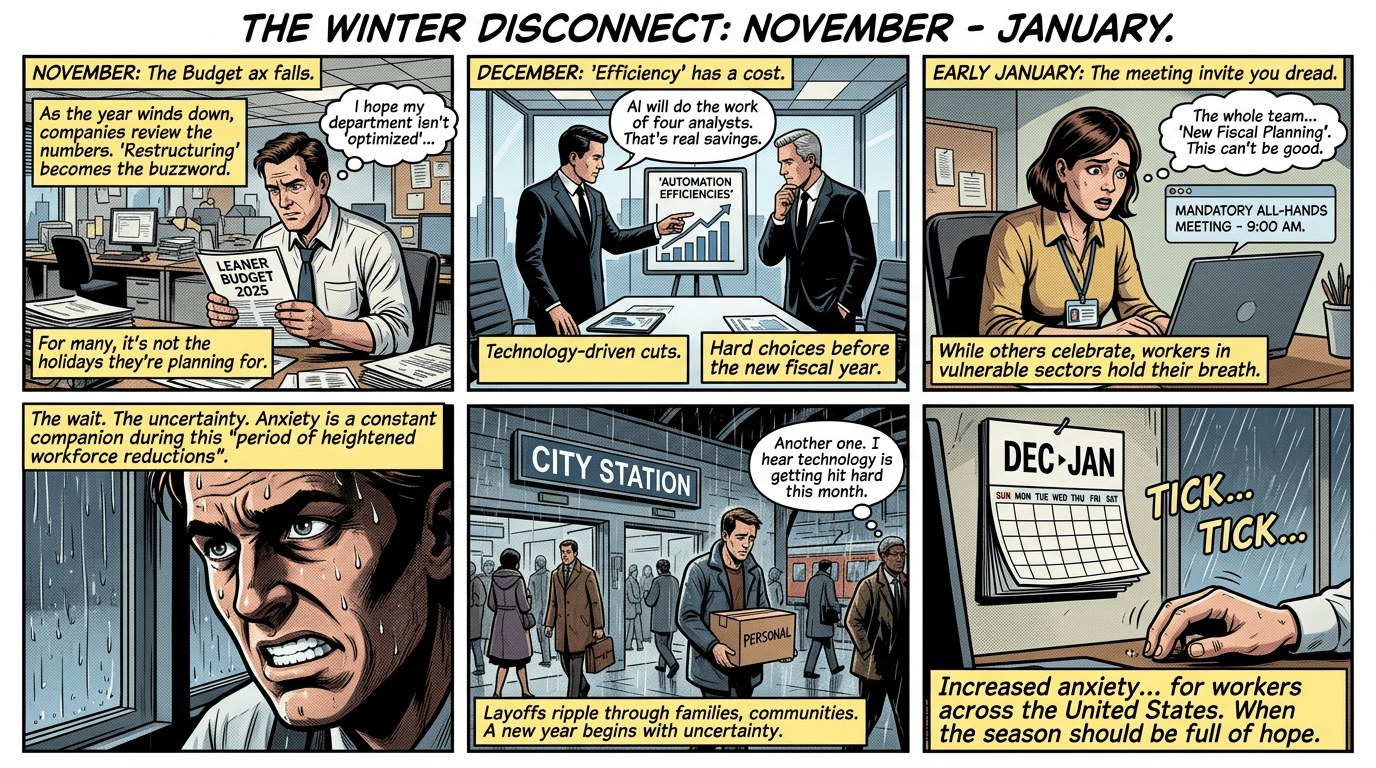
Every year, the period between November and January brings increased anxiety for workers across the United States. While layoffs can occur at any time, year-end budget reviews, strategic restructuring, technology-driven efficiencies, and new fiscal-year planning often make late fall and early winter a period of heightened workforce reductions. Workers in technology, finance, retail, and professional services are particularly vulnerable during this period.
While no one can predict future economic conditions with certainty, several economic indicators suggest an ongoing economic slowdown rather than sustained expansion. Higher interest rates, reduced business investment, slowing consumer spending, continued restructuring within the technology sector, and persistent workforce reductions across multiple industries have contributed to increasing labor-market uncertainty. Recent data from the Bureau of Labor Statistics continue to show significant levels of layoffs and discharges across the United States, while employers remain cautious about hiring and expansion. As organizations focus on efficiency, automation, and artificial intelligence adoption, workers should prioritize career resilience by maintaining current skills, expanding professional networks, developing multiple income streams, and preparing for potential workforce disruptions before they occur.
One of the least discussed career-protection tools is the Worker Adjustment and Retraining Notification (WARN) Act. The federal WARN Act generally requires covered employers with 100 or more employees to provide 60 days advance notice before certain plant closures and mass layoffs. Yet many employees are never informed that these notices are often publicly available long before layoffs occur.
Checking state WARN notice databases and public WARN trackers can provide valuable insight into whether your employer has announced a major workforce reduction. While not all employers are covered and exceptions exist, reviewing WARN notices allows employees to prepare proactively rather than reactively.
Recent labor market data from the Bureau of Labor Statistics reported approximately 1.6 million layoffs and discharges nationally, highlighting the continued reality of workforce instability. Economic uncertainty, higher interest rates, automation, artificial intelligence adoption, and changing consumer spending patterns continue to influence workforce decisions.
To prepare for layoff season, begin updating your resume immediately. One of my favorite tools is Resume.co. They do not sponsor me, although they probably should considering how often I recommend it to clients and colleagues. Resume.co provides modern templates, ATS-friendly formatting, and efficient editing tools that help job seekers present their qualifications professionally.
Job seekers should also test their resumes against Applicant Tracking Systems (ATS). Many employers use AI-driven resume screening software. When optimizing ATS systems, use standard section headings, include relevant keywords from the job description, avoid excessive graphics, and maintain clear formatting.
A growing body of research suggests that job seekers must understand how ATS software evaluates resumes. Research from Harvard Business School and Accenture found that employers increasingly rely on automated screening tools to filter and rank applicants before a recruiter reviews them. These systems often prioritize keyword matching, specific credentials, and standardized experience patterns, which can disadvantage otherwise qualified candidates whose resumes use different terminology or reflect nontraditional career paths. As a result, applicants should customize their resumes for each position, incorporate language from the job description, and ensure that their resumes are formatted in a manner that ATS software can accurately parse.
Beyond resume preparation, workers should focus on monetizing their expertise online. Building a portfolio website, maintaining a professional LinkedIn presence, creating educational content, developing digital products, and offering freelance services can create additional income streams. Economic resilience increasingly depends upon multiple sources of income rather than relying solely on a single employer.
This is one reason my consulting company, Wicked B of the West Business Consulting, provides guidance on remote work, leadership development, process design, accessibility accommodations, and professional branding. I also offer training on building professional online visibility and creating sustainable remote career opportunities.
For professionals seeking to strengthen their leadership capabilities during uncertain times, consider taking the Workplace Leadership Health Check and attending my webinars focused on future-of-work readiness, remote leadership, and organizational resilience.
I also encourage readers to explore my book, which examines leadership, workplace culture, psychological safety, workplace trauma, and organizational health. The skills discussed in the book are increasingly relevant as organizations continue adapting to economic uncertainty and workforce transformation.
While no one can predict the future with certainty, labor-market indicators suggest continued volatility. The best strategy is preparation. Monitor WARN notices, maintain an updated resume, diversify income streams, strengthen your professional network, and continue developing skills that remain valuable regardless of economic conditions.
References
Bureau of Labor Statistics. (2026). Job openings and labor turnover survey. https://www.bls.gov/jlt/
Worker Adjustment and Retraining Notification Act, 29 U.S.C. § 2101 et seq.
Tu, V. (n.d.). Your Rich BFF content on career and financial literacy topics.
Fuller, J. B., Raman, M., Rawlins, D., Rice, K., & Tippett, N. (2021). Hidden workers: Untapped talent. Harvard Business School Project on Managing the Future of Work and Accenture.
Ready to see how your workplace scores? Take the Workplace Leadership Health Check™ today:
Survey Link: https://csustan.co1.qualtrics.com/jfe/form/SV_bvd9FFz2MyRUUyW
Whether you’re an employee, leader, HR professional, or business owner, this assessment can provide valuable insights into the health of your workplace. We look forward to sharing resources that help organizations build stronger teams, healthier cultures, and more effective leadership practices.
Book Spotlight
Remote Work Is Here to Stay: Rethinking Operations Management in the Modern Work Era
Available on Amazon: https://www.amazon.com/dp/B0H5BPJCHJ
As businesses continue adapting to changing work environments, operational excellence and effective remote leadership remain critical skills for success.
Thank you for reading. If you enjoy this content, like and subscribe. If you are interested in consulting services, please feel free to connect with me through my social media channels.
Remember: Remote is here to stay.
Website: wickedbofthewestconsulting.com
YouTube: https://www.youtube.com/@Wickedbofthewest
Facebook: https://www.facebook.com/WickedBoftheWestBusinessConsulting
Instagram: https://www.instagram.com/wickedbofthewestconsulting/
LinkedIn: https://www.linkedin.com/in/stephanie-diana-eubank-dba/
Company LinkedIn: https://www.linkedin.com/company/wicked-b-of-the-west-business-consulting
TikTok: @drstephanieeubank
Blog: drstephaniebeardbaremoteresearch.org
Email: wickedbofthewestconsulting@gmail.com

